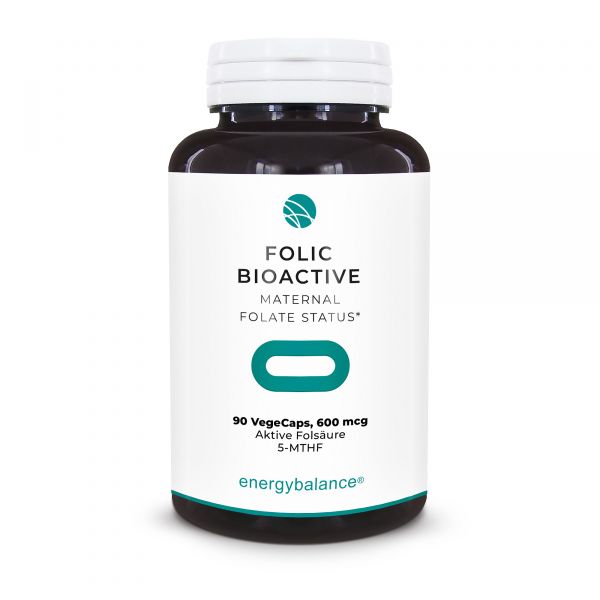
5-MTHF or 5-methyl-tetra-hydro-folic acid is an active folate from glucosamine that is absorbed directly through the intestine. The folic acid used by EnergyBalance®, called Quatrefolic®, is characterised by a long-lasting stability, a particularly high water solubility and a resulting improved bioavailability.
What is the difference between folate and folic acid?
EnergyBalance® uses a patented and very high-quality folic acid called Quatrefolic®. It is characterised by a long-lasting stability, a particularly high water solubility and a resulting improved bioavailability.
Folic acid is a vital substance that must be supplied to the body with food. Quatrefolic® is the glucosamine salt of 5-MTHF and offers the most bioavailable form of reduced folate on the market. Folic acid and also food folate are not biologically active and must be converted to the metabolically active 5-methyltetrahydrofolate (5-MTHF) in a multi-step process, in which the enzyme methylenetetrahydrofolate reductase (MTHFR) plays a key role.
This important conversion process, often referred to as the methylation cycle, is a network of interconnected biochemical reactions in which a carbon methyl group is transferred from one compound to another. Folate and methionine are the key components of the methylation cycle and are needed for normal and healthy cell function.
This process occurs in all cells of the body and is critical for a variety of functions of the human body.
What is the difference between folate and folic acid?
Folic acid is a general term for a group of water-soluble B vitamins and is also known as vitamin B9. Folic acid is a pure synthetic compound that does not exist in this form in nature. The natural form found in food is folate. In humans, the most important metabolite is 5-MTHF 5-methyl-tetra-hydro-folate, with a share of more than 90%. The conversion of synthetic folic acid into its biologically active form must be carried out by the body with the help of an enzyme, methylenetetrahydrofolate reductase (MTHFR). Only this enzyme enables the conversion of folic acid into 5-MTHF.
Unfortunately, this enzyme is not present in the same way in all people, i.e. the synthetic folic acid is much less able to be converted into the natural metabolite (these are substances that are formed as intermediates or as degradation products of metabolic processes of the organism). This problem is very common. Overall, about 50% of all women in Central Europe are affected. Therefore, supplementation makes sense - especially for pregnant women in the first third of pregnancy or, ideally, beforehand if you are planning to have a child, folate should definitely be taken daily. If you wish to have a child or are pregnant, please consult your doctor before taking folate.
What are the consequences of a folate deficiency?
A folic acid deficiency unfortunately leads to a variety of symptoms such as anaemia and diarrhoea, and it even increases the risk of dementia in old age. Folic acid deficiency during pregnancy means an increased risk of malformations of the neural tube (spina bifida - open back) in the child.
(Source: German Nutrition Society)
What is the recommended intake of folate equivalents?
The recommended intake of folate equivalents depends on a person's age. For adolescents and adults it is 330 µg (micrograms) per day. Pregnant and lactating women have an increased requirement, so the recommended intake for pregnant women is 600 µg of folate equivalents per day; 500 µg per day for women who are breastfeeding (Source: epsa (European Food Safety Authority) - Dietary Reference Values for the EU).
Why should women who want to become pregnant and women in the first trimester of pregnancy take additional folic acid?
Neural tube defects (NTDs) are a group of conditions in which are openings in the spinal cord or brain that remain from early in human development. In the 3rd week of pregnancy called gastrulation, specialized cells on the dorsal side of the embryo begin to change shape and form the neural tube. When the neural tube does not close completely, an NTD develops. A fetus’s neural tube should usually close during the first 4 weeks of pregnancy. An inadequate supply of folate during this critical phase increases the risk of NTD. There are various causes of neural tube defects, but studies have shown that such defects can be reduced by taking folic acid supplements.
Women should start to take the folic acid supplements 4 weeks before the beginning of pregnancy. Since many pregnancies are not planned , many women do not know that they are pregnant and therefore should take min. 500 µg folic acid preventive per day in addition to a folate-rich diet, in order to avoid NTDs. In any case, a folic acid supplement should be taken during the first trimester of pregnancy (Source: German Nutrition Society).
Foods enriched with folic acid or supplements?
Regardless of folate intake through their diet, pregnant women during the first trimester of pregnancy and women who want to or could become pregnant are more save when they take a food supplement that contains 500 µg of folic acid. It is the best way to ensure the quantity of 500 µg, than eating enriched foods, where the quantity of folic acid is more difficult to measure.
Energy Balance ™ folate is a natural source for folic acid and has several advantages:
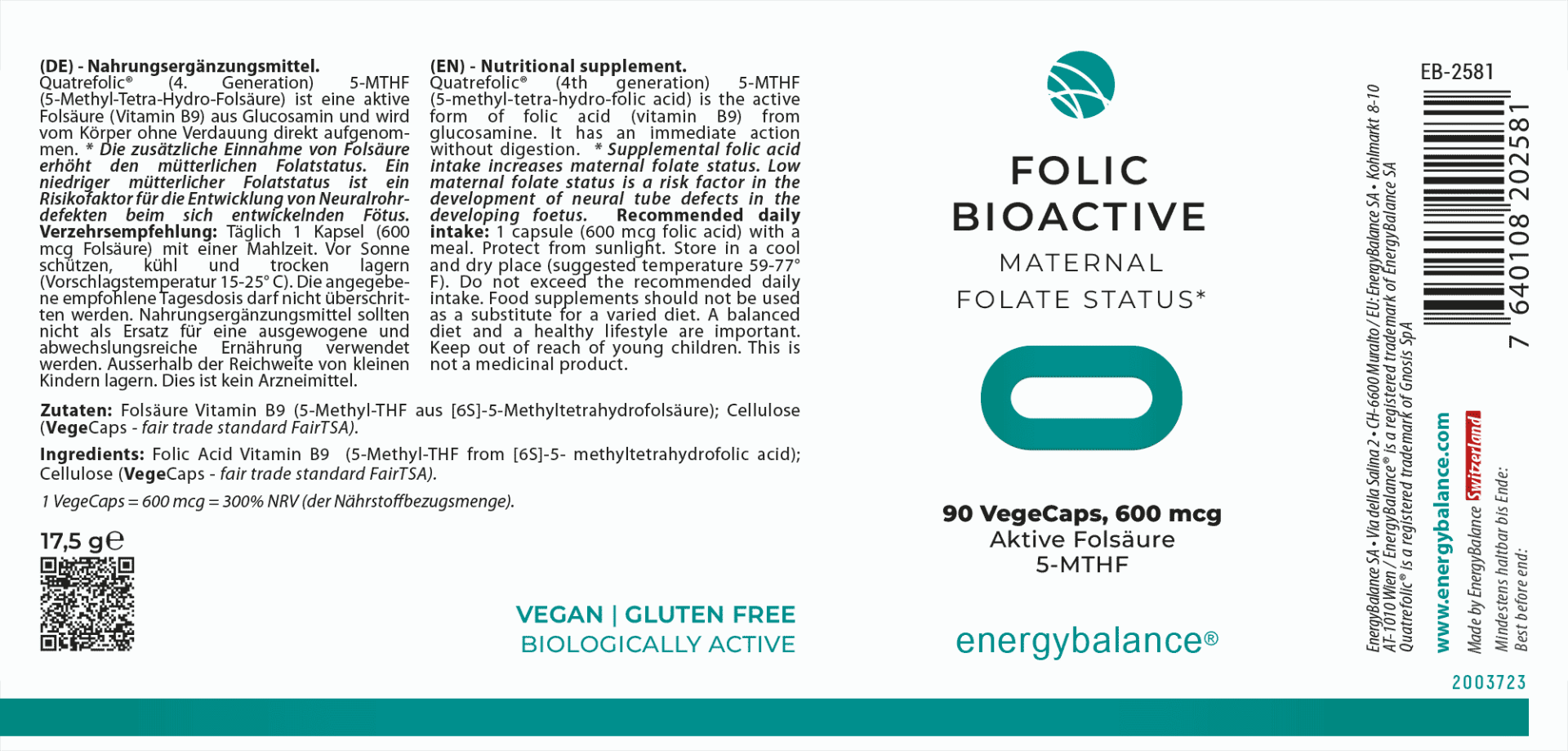
EnergyBalance® Folate contains no artificial colors, preservatives, gluten or lactose. Vegan.
Dosage
1 capsules (600 µg (ig) folic acid) with a meals per day.
Contents
5-Methyl-THF from [6S]-5-methyltetrahydrofolic acid, cellulose (VegeCaps).
Read more about this in the encyclopedia
Interesting study about 5-MTHF: Page 13.
| Manufacturer | EnergyBalance |
|---|---|
| Weight | 0.060000 |
| EAN | 7640108202581 |
| Application | Blood formation, Brain, Cell divison, Digestion, Energy, Immune system, Metabolism, Pregnancy, Tiredness |
| Dosage form | VegeCaps |
| Vegan | Yes |
| plasticfree | No |
© Copyright: The content provided by us on our website, such as text, graphics, logos, button icons, images, digital downloads and data collection, is the property of EnergyBalance SA or third parties who supply us with content or make content available on the website, and is protected by Swiss and international copyright and database law. In addition to the entire content of our online offerings, the content of our database is the exclusive property of the EnergyBalance SA and is protected by Swiss and international copyright and database law.

 deutsch
 italiano